

I. Overview of 28S–32S High-Voltage Drone Batteries & Dedicated Charging Systems
1.1 Technical Characteristics of 28S–32S Industrial High-Voltage Smart Drone Batteries
The "S" in drone battery specifications stands for series, indicating the number of lithium cells connected in series within the pack. A 28S drone battery integrates 28 cells in series, while a 32S drone battery uses 32 cells. Based on the industry-standard 3.7V nominal voltage per lithium-polymer cell, a 28S battery pack delivers a 103.6V nominal voltage and a 32S pack reaches 118.4V, both classified as industrial-grade high-voltage power batteries. This high-series architecture enables high-voltage, high-power output to support heavy-load flight, long-range inspection and large-area surveying missions for large professional drones.
28S–32S high-voltage drone batteries are widely deployed in industrial UAV scenarios that demand high payload capacity and reliable power delivery. Surveying and mapping drones leverage the high energy density of these batteries to support longer, continuous long-distance missions and expand coverage per flight. For power line inspection drones and emergency rescue drones — which operate under strict requirements for power stability and environmental adaptability — this battery series features a standardized Battery Management System (BMS) that regulates battery status in real time, adapts to extreme temperatures and harsh airflow conditions, and ensures consistent, uninterrupted power output.
Compared with standard low-voltage consumer drone batteries, 28S–32S high-voltage smart drone batteries offer substantial performance advantages. Conventional civilian drone batteries typically deliver 200–250Wh/kg energy density, while industrial-grade 28S–32S high-voltage batteries reach 280–300Wh/kg, significantly boosting energy storage efficiency. At equal weight, these batteries deliver longer flight time and greater power headroom for heavy-duty operations. The built-in BMS also provides multi-layer protection against overcharge, over-discharge, over-temperature, over-current and cell imbalance, preventing abnormal battery degradation at the hardware level and extending cycle life — a critical advantage not available on basic batteries without intelligent management.
1.2 Role & Technical Value of Dedicated High-Voltage Drone Battery Chargers
Dedicated chargers for 28S–32S high-voltage drone batteries are not simple AC-to-DC power conversion devices; they are core collaborative components of the complete high-voltage drone charging system. Beyond supplying power, they work in tandem with the battery BMS to dynamically adjust charging strategies, enforce safety thresholds and adapt to cell condition. They are critical hardware for ensuring safe, standardized charging of high-voltage drone batteries, and directly determine charging efficiency and long-term battery health over the full lifecycle.
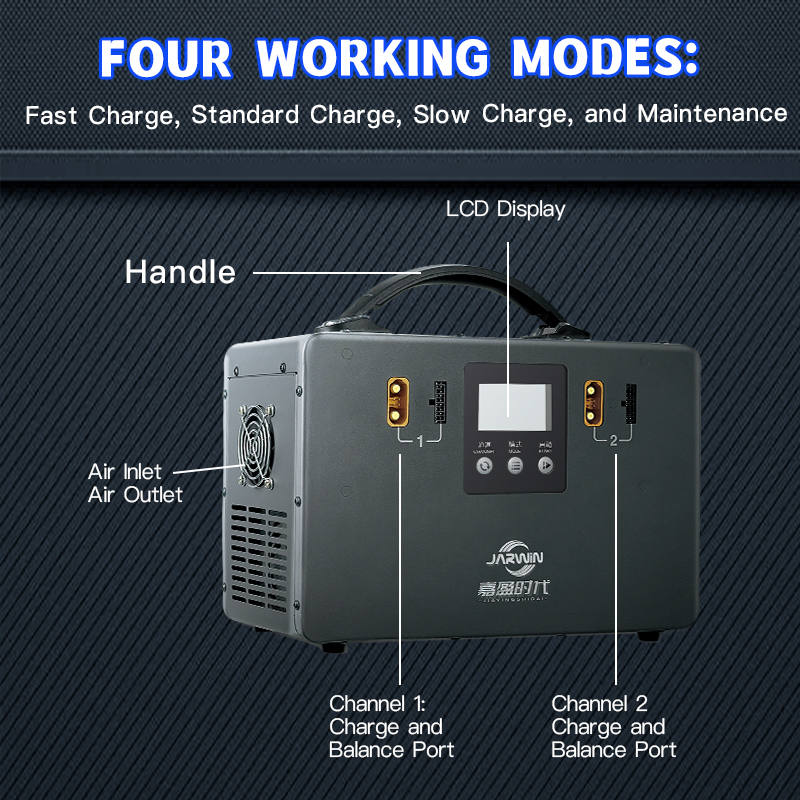
High-voltage drone chargers on the market fall into two primary categories, each suited to different operational scenarios:
- Fast charging mode uses high-current, high-power output and can recharge a depleted battery to 80% rated capacity in 30 minutes or less. It is ideal for time-sensitive missions such as emergency rescue, urgent surveying and continuous multi-batch operations. However, fast charging operates at higher current and voltage levels, which increases battery polarization and heat generation. Frequent long-term fast charging accelerates chemical degradation of cells, raises internal resistance and shortens cycle life. It is recommended only for emergency use, not for daily routine charging.
- Slow charging mode is the standardized conventional charging solution, using low-current steady-state output with a full charge cycle of 5–8 hours. This mode produces minimal polarization and uniform heat generation, effectively preventing cell structural damage caused by fast charging, preserving lithium cell chemical activity, slowing aging and optimizing cycle life. For non-emergency operations and daily equipment maintenance, slow charging is the optimal choice for long-term reliability of high-voltage drone batteries, and is the industry-standard practice for regular charging.
 II. Why BMS-to-Charger Communication Handshake Is Critical for High-Voltage Drone Batteries
2.1 Core Functions of the Drone Battery Management System (BMS)
The Battery Management System (BMS) is the central control unit of a high-voltage smart drone battery. It handles status monitoring, risk protection, parameter regulation and cell balancing, serving as the intelligent core for safe battery operation — and the only data interface between the battery pack and the charger.
Real-time parameter monitoring is the foundational function of the BMS. The system collects core operating data 24/7, including total pack voltage, individual cell voltage, charge-discharge current and battery surface temperature. Individual cell voltage monitoring is especially critical for 28S–32S multi-series architectures: even minor parameter deviation in one cell can impact the performance and safety of the entire pack. The BMS detects early warning signs such as cell over-voltage, under-voltage and abnormal voltage fluctuation, providing data support for charging regulation and fault alerts.
Charge-discharge current monitoring enables safe power control. Excessive charge or discharge current causes instantaneous overload, intensified internal polarization and rapid heat buildup, which not only accelerates battery aging but also creates thermal runaway risks. Through real-time current sampling, the BMS strictly constrains charge and discharge currents within the battery’s rated safety range, eliminating hazards and performance loss from over-current conditions.
Temperature monitoring and thermal regulation are essential for safe high-voltage battery operation. Lithium batteries perform optimally within a 20–40°C operating range. Excessively high temperatures can trigger cell thermal runaway, while excessively low temperatures reduce cell activity and charging acceptance. The BMS captures real-time battery temperature data and coordinates with cooling and heating auxiliary modules to keep the battery within its safe operating range, supporting reliable operation and charging in complex field environments.
Overcharge and over-discharge protection are core safety features of the BMS. Overcharging causes electrolyte decomposition and internal pressure buildup, which can lead to swelling, fire or even explosion. Over-discharge causes irreversible loss of cell activity and permanent capacity fade. Using precision State of Charge (SOC) algorithms, the BMS estimates battery level in real time, automatically cutting or reducing charging power at full charge, and triggering low-voltage protection with emergency landing commands at critically low charge levels to fully prevent overcharge and over-discharge failures.
Cell balancing is a signature function of multi-series high-voltage batteries. Due to manufacturing tolerances and uneven wear during use, individual cells gradually diverge in capacity and voltage over time, degrading overall pack performance and reducing flight time. Using active balancing or passive balancing technology, the BMS discharges over-voltage cells and replenishes under-voltage cells to maintain consistency across the pack, maximizing overall battery performance and extending service life.
2.2 Key Benefits of BMS-Charger Communication for Drone Batteries
- Charging safety assurance: Communication handshake is the foundational safety layer for high-voltage drone battery charging. 28S–32S systems operate at high voltage levels with extremely narrow fault tolerance; blind charging without data interaction carries a high risk of over-voltage, over-current and thermal runaway incidents. Through two-way BMS-to-charger communication, the battery transmits its maximum safe charging voltage and current limits to the charger in real time. The charger dynamically adjusts its output based on live battery status, keeping all charging parameters strictly within the safety envelope and eliminating high-voltage charging hazards at the source.
- Extended battery cycle life: Communication handshake enables dynamic optimization of the charging curve to slow battery aging. Over a battery’s lifecycle, internal resistance, chemical activity and charging acceptance change continuously with cycle count, storage time and operating conditions — fixed charging parameters cannot adapt to these changes. The BMS collects real-time data including State of Health (SOH), charge-discharge cycle count and internal resistance, transmits it to the charger via the communication link, and the two systems co-optimize the charging profile. This delivers a refined charging sequence: constant-current fast charging in the early stage, followed by constant-voltage trickle charging at the end, reducing polarization damage and effectively extending battery cycle life.
- Improved charging efficiency: Communication handshake enables precise parameter matching to boost operational efficiency. Charging speed depends heavily on how well the charger’s rated output aligns with the battery’s live SOC, temperature and internal resistance. Through two-way data exchange, the charger quickly identifies the battery’s real-time condition: it applies optimized fast-charging parameters when the battery is healthy and ambient temperature is suitable, and automatically reduces power for gentle steady-state charging when the battery is degraded. This balances charging speed and battery health, drastically reduces equipment downtime for recharging and improves operational continuity.
III. Core Verification Parameters in Drone Battery Charging Communication
3.1 Voltage Verification Parameters
Charging voltage is the primary controlled parameter in high-voltage battery charging, and matching accuracy directly impacts both safety and usable capacity. Overly high charging voltage exceeds the cell’s withstand limit, causing electrolyte decomposition, cell swelling and thermal runaway. Overly low charging voltage prevents full saturation, leaving usable capacity untapped; long-term under-voltage charging also causes cell activity passivation and progressive capacity fade. Compared with low-voltage packs, 28S–32S high-voltage batteries have a much narrower voltage tolerance window and require far higher parameter verification accuracy, due to their large number of series-connected cells.
Precise voltage matching relies entirely on real-time communication between the BMS and the charger. At charging initiation, after the BMS completes full-pack voltage sampling, individual cell voltage checks and consistency evaluation, it sends the battery’s compatible charging voltage range and full-charge cut-off voltage to the charger. The charger then generates a customized voltage strategy based on its own output capabilities and the battery’s specifications, eliminating the mismatch risks of fixed-voltage output.
High-voltage drone battery charging follows two core stages: Constant Current (CC) and Constant Voltage (CV). In the early charging phase, when SOC is low and voltage delta is large, the charger delivers rated safe constant current for fast replenishment. As charging proceeds, battery terminal voltage rises; when it approaches the full-charge threshold, the system automatically switches to constant-voltage mode, maintaining stable voltage while gradually tapering the charging current to prevent overcharge.
3.2 Current Verification Parameters
Charging current dictates charging speed and battery wear, and is the key parameter for balancing efficiency and longevity. High-current charging delivers fast replenishment but increases battery polarization, heat generation and internal resistance; sustained high-current fast charging causes irreversible cell damage. Low-current steady-state charging causes less wear and is safer, but takes far longer and cannot support urgent missions. Given the high power base of 28S–32S high-voltage batteries, dynamic current regulation is especially critical.
Dynamic current matching is driven by BMS data feedback. The BMS calculates the maximum safe charging current for current conditions based on real-time battery temperature, SOC, internal resistance and SOH, and transmits this value to the charger via the communication link. The charger then dynamically adjusts its output current amplitude. In low-temperature environments where cell activity is reduced, the BMS proactively limits current to prevent cell damage. Under normal temperature and low-SOC conditions, the system enables high-current fast charging to maximize replenishment speed. When SOC nears 100%, it automatically switches to low-current trickle charging to ensure full cell saturation and avoid localized overcharge.
3.3 Battery Status Verification Parameters
- SOC (State of Charge) is the baseline reference for charging strategy adjustment, acting as the battery’s operational status gauge. The BMS calculates accurate real-time remaining capacity using a fusion algorithm of coulomb counting, voltage correction and temperature compensation, and shares this data with the charger. The charger divides the charging process into stages by SOC gradient: high-power fast charging at low SOC, gradual power reduction and voltage stabilization at medium-high SOC, and charge termination at full SOC. This staged, refined charging delivers both efficiency and safety.
- SOH (State of Health) is the core metric reflecting a battery’s lifecycle degradation, and directly determines how charging strategies are calibrated. As cycle count increases, battery rated capacity fades, internal resistance rises and overall health declines. The BMS accurately calculates SOH by analyzing charge-discharge curves, internal resistance trends and capacity decay rates. For aged batteries with low SOH, the charger automatically activates a flexible charging profile, reducing charging voltage and current to slow further degradation, prevent accelerated wear from high-intensity charging, and maximize the remaining service life of older packs.
IV. Why Intelligent Communication Outperforms Manual Settings for High-Voltage Drone Charging
4.1 Complexity of 28S–32S Drone Battery Charging Scenarios
28S–32S high-voltage drone batteries are designed for heavy-load, long-duration, high-cycle industrial drone missions, meaning charging scenarios are highly dynamic, high-risk and precision-dependent. These drones are used for heavy-lift logistics, full-area surveying, power transmission line inspection, emergency response and other demanding applications with high operational intensity and heavy battery drain. They often require frequent recharging and operation in complex, variable field environments. Additionally, the complex series architecture of high-voltage packs means small variations in individual cell parameters, ambient temperature swings and battery health differences all shift the safe charging threshold — fixed parameters cannot adapt to these dynamic conditions.
4.2 Limitations of Manual Charging Parameter Configuration
Manual parameter setting for high-voltage drone battery charging suffers from inherent flaws: limited accuracy, no real-time adjustment and low fault tolerance. Manual setup relies entirely on operator experience, with no standardized data support, and is prone to parameter mismatch. Operators also cannot monitor cell status, temperature and internal resistance changes in real time, making it impossible to adjust charging parameters dynamically to match high-voltage operating conditions. In field practice, cases of battery overheating, cell damage and sudden capacity drop have repeatedly occurred due to manually configured fast-charging parameters that failed to account for low battery temperature or advanced aging. These faults directly reduce drone operational reliability and equipment service life, and in severe cases can cause thermal runaway safety accidents.
4.3 Advantages of Smart Communicative Charging for Industrial Drones
Intelligent charging, powered by two-way BMS-to-charger communication, resolves the drawbacks of manual setup and adapts seamlessly to complex high-voltage operating conditions. The system captures full-dimensional battery data — voltage, current, temperature, SOC, SOH — in real time, and adjusts charging power, voltage and current at millisecond scale for fully adaptive control. It automatically reduces power for cooling in high-temperature conditions, applies gentle pre-charging to activate cells in low-temperature conditions, uses low-wear profiles for aged batteries, and deploys high-efficiency fast charging for new packs. This mode requires no manual intervention and delivers fully automated, intelligent charging management. While eliminating safety risks, it achieves the optimal balance between charging speed and battery longevity, making it the best technical solution for high-voltage drone battery charging.
V. Conclusion & Future Trends for High-Voltage Drone Charging Technology
In summary, the two-way communication mechanism between 28S–32S high-voltage smart drone batteries and their chargers is an indispensable core technology for high-voltage charging systems, with direct impact on operational safety, battery service life and mission efficiency. BMS-charger communication handshake eliminates over-voltage, over-current and thermal runaway risks at the safety level; optimizes charging curves dynamically to reduce cell wear at the lifecycle level; and delivers precise parameter matching to accelerate replenishment at the efficiency level. Real-time verification and dynamic adaptation of three core parameters — voltage, current and battery status — underpin the entire intelligent charging mechanism. Compared with manual fixed-parameter setup, it offers decisive advantages in accuracy, real-time responsiveness, safety and adaptability, and is fully suited to the complex operating conditions of industrial high-voltage drones.
Looking ahead, high-voltage drone battery charging technology will continue evolving toward higher energy density, ultra-fast charging, fully intelligent adaptation and enhanced safety. Advances in battery cell materials will further boost energy density and flight endurance. Refinements in intelligent charging algorithms will enable millisecond-level parameter adaptation, full-domain fault prediction and proactive safety protection. Meanwhile, interconnection between batteries and charging infrastructure will deepen, enabling unmanned automatic charging, cloud-based data monitoring and full-lifecycle intelligent O&M — drastically reducing equipment maintenance costs and operational risks.
Post time: Aug-21-2026