

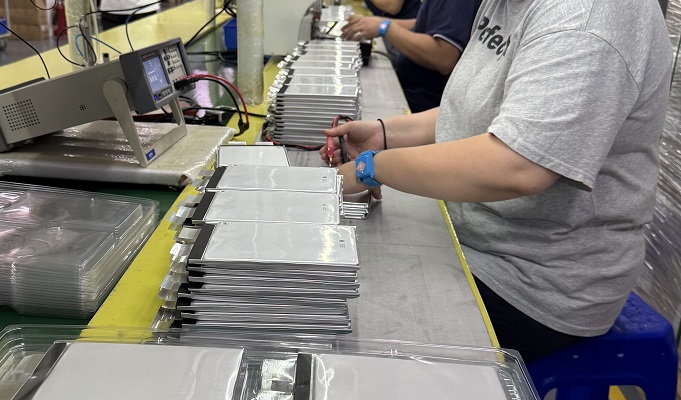
 As lithium battery applications become increasingly diverse, B2B customers are moving away from off‑the‑shelf products toward custom solutions. Whether for drone logistics, industrial & commercial energy storage, specialty robotics, or portable medical devices, each scenario demands different specifications for voltage, capacity, dimensions, discharge rate, ingress protection, and battery management system (BMS) strategies.
As an experienced manufacturer with years of expertise in the lithium battery industry, Kabit has compiled this Complete Guide to Custom Lithium Batteries. Our goal is to help customers clearly define their needs before a project starts – reducing communication cycles, lowering development costs, and ensuring right‑first‑time delivery.
Customization Process: Seven Steps to Efficient Delivery
Kabit follows a structured seven‑step process, with full transparency at every stage:
Requirements Review
Initial discussion; our technical team conducts a feasibility assessment.
Solution Design
Based on your needs, we propose cell selection, BMS architecture, and structural design.
Quotation & Contract
Development fees, sample costs, and volume pricing are finalized.
Sample Assembly
R&D team performs cell matching, BMS programming, and assembly.
Performance Testing
Comprehensive tests including charge/discharge, temperature extremes, short‑circuit protection, vibration, and more.
Sample Delivery
Samples are shipped for your on‑site validation.
Mass Production
After sample approval, we move into volume production with consistent quality.
Before You Start: 8 Critical Parameters to Define
Accurate customization starts with accurate inputs. Please prepare the following key information before initiating your project:
1. Connector Definition
Output connector type, pin assignments, and communication protocol (e.g., RS485, CAN).
2. Ingress Protection (IP) Rating
Required IP level based on operating environment (e.g., outdoor storage typically needs IP65 or higher).
3. Mounting Method
Space constraints, fixing mechanism, and weight limits in your device.
4. Dimensions
Length, width, height tolerances for the battery pack.
5. Cycle Life
Target number of charge/discharge cycles and capacity retention at end‑of‑life.
6. Operating Profile
Continuous discharge duration, standby time, and charge/discharge transition logic.
7. Peak Power
Maximum current and duration (critical for drones, power tools, etc.).
8. Voltage Range
Nominal voltage, charge/discharge cut‑off voltages, and permissible fluctuation.
Application‑Specific Requirements – Which Category Do You Fit Into?
Different applications emphasize different performance metrics. Below are the key focus areas for three major scenarios:
1 Drones & Robotics
Core Needs: High‑rate discharge, light weight, high safety.
Key Parameters: Peak power (continuous discharge up to 5C–10C), energy density (affects flight time), structural robustness (shock and vibration resistance).
A logistics drone operator needed 30‑minute flight time with a 5kg payload, while maintaining >80% discharge efficiency at ‑10°C. Kabit delivered a solution using high‑rate lithium cobalt oxide (LCO) cells and an intelligent BMS with active heating, meeting all requirements.
2 Energy Storage & Telecom Base Stations
Core Needs: Long cycle life, high reliability, wide operating temperature range.
Key Parameters: Cycle life (thousands of cycles for LFP chemistry), IP rating (IP65 or higher for outdoor use), BMS capabilities (balancing and remote monitoring).
An industrial & commercial storage client required <20% capacity degradation over a 10‑year warranty period under daily cycling. Kabit used Grade‑A cells and an active‑balancing BMS to achieve a 15‑year design life.
3 Consumer & Portable Devices
Core Needs: Custom shapes, connector compatibility, cost‑effectiveness.
Key Parameters: Form factor (ability to create non‑standard shapes), connector definition (seamless integration with host PCBs), development speed (fast sample turnaround).
A portable medical device needed a battery to fit into a very tight, irregularly shaped compartment, with delivery in under 18 working days. Kabit’s flexible design and rapid prototyping system completed delivery in 16 working days and passed customer qualification.
Frequently Asked Questions About Customization
Q: What are the development costs?
Custom lithium batteries typically involve tooling/mold costs, engineering development fees, and sample material costs. The total depends on design complexity, cell selection, and BMS architecture. Kabit provides a detailed cost breakdown so every expense is clear and transparent.
Q: How long does development take?
For standard projects, sample delivery usually takes about 30 working days from spec approval. For urgent programs, Kabit offers an expedited track that can compress the timeline to as little as 15 working days.
Q: What is the minimum order quantity (MOQ)?
MOQ varies based on cell type and structural complexity. Kabit supports full‑service from prototyping to mass production – even small‑batch custom orders are welcome. MOQ can be negotiated during the requirements review phase.
Q: Can custom batteries obtain international certifications?
Yes. Kabit can facilitate UL, CE, UN38.3, RoHS, and other certifications as required, ensuring your product complies with target market regulations.
Q: What about warranty and after‑sales support?
Kabit offers a standard warranty period (specific terms per contract) and maintains a professional after‑sales team. We provide remote technical support 24/7 and on‑site service when needed.
Why Choose Kabit for Your Lithium Battery Customization?
Years of Technical Expertise
Our team has deep R&D and manufacturing experience in cells, BMS, and structural design.
Scalable Production Capacity
Multiple manufacturing bases ensure reliable delivery from prototypes to high‑volume orders.
Rigorous Quality Control
We follow strict quality management systems (ISO9001, IATF16949) with end‑to‑end inspection from incoming materials to finished goods.
Flexibility
We support small and medium‑batch customization, offering a step‑by‑step path from sample to pilot to mass production, accompanying you from development to market launch.
Start Your Customization Project Today
Looking for a reliable partner for custom lithium batteries? Whether your application is drones, energy storage, robotics, or specialty industrial equipment, Kabit provides a one‑stop solution – from requirements analysis to mass production.
Contact us now for a technical assessment and a free quotation.
Post time: Jul-02-2026