

The rapid advancement of electric vehicles and high‑power electronic devices has fueled the growing demand for ultra‑fast‑charging lithium‑ion batteries. Nevertheless, current lithium‑ion rechargeable batteries suffer from severe power decay during fast‑charging processes and may even lead to catastrophic failures, which raises safety risks. This mainly originates from electrochemical instability at the anode‑electrolyte interface, triggering harmful metallic‑lithium deposition on the battery surface and poor thermal stability.
In recent years, high‑voltage anode materials have become highly promising alternatives for inhibiting excessive lithium deposition and the formation of unstable solid‑electrolyte interphase (SEI) layers. Despite these strengths, state‑of‑the‑art materials are still limited by unsatisfactory ionic conductivity and thermal stability, which weaken power output and long‑term reliability.
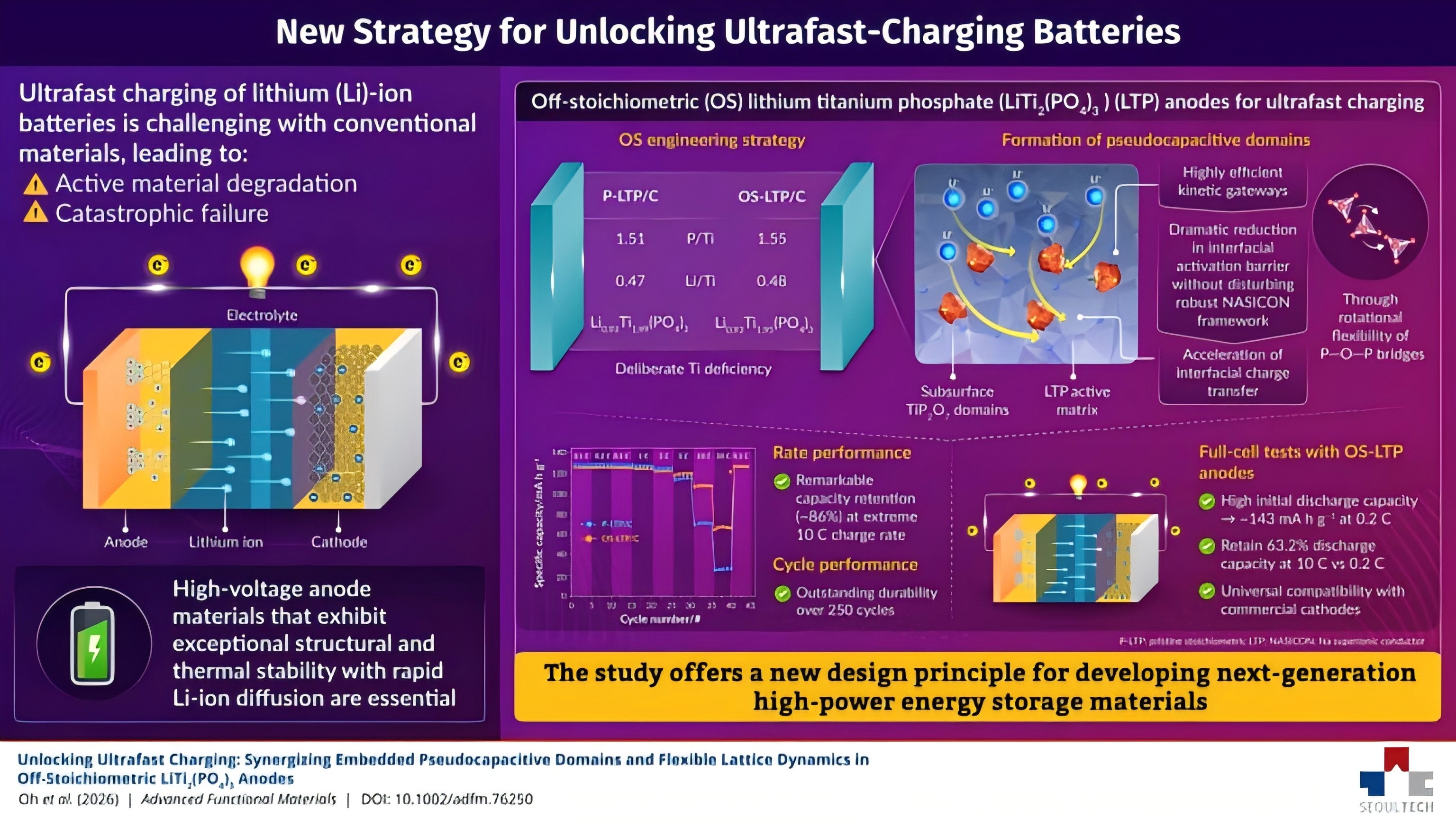
According to foreign‑media reports, to resolve these problems, a research team headed by Associate Professor Dongwook Han at Seoul National University of Science and Technology has developed an off‑stoichiometric (OS) lithium titanium phosphate anode material with an NASICON‑type structure. This material is well‑known for exceptional structural and thermal stability. The design can induce spontaneous phase transformation underneath the surface of active‑material particles to break through kinetic restrictions and achieve stable fast‑charging performance.
Relevant research findings have been published in the journal Advanced Functional Materials.
Surface Modulation for Accelerated Ion Transport
Lithium titanium phosphate (LTP) possesses a sodium‑super‑ionic‑conductor (NASICON)‑type structure, which boasts outstanding structural and thermal stability as well as rapid lithium‑ion diffusion channels. To tap into its full‑scale potential, researchers adopted an off‑stoichiometric design strategy and deliberately increased the ratio of phosphorus (P) to titanium (Ti). Such titanium‑deficient composition generates titanium phosphate (TPO) domains close to the surface of LTP particles.
These TPO‑rich regions act as high‑efficiency kinetic channels, lowering the energy barrier for lithium‑ion transportation across the anode‑electrolyte interface and constructing fast ion‑transfer pathways near particle surfaces. Besides, highly flexible P‑O‑P bonds within the TPO framework provide structural flexibility to adapt to volume variation during fast‑charging cycles and protect the NASICON‑type structure against irreversible damage.
Sturdy Performance under Fast‑charging Circumstances
Accordingly, in rate‑capability tests, the vital indicator that evaluates fast‑charging capacity, the OS‑LTP‑carbon (OS‑LTP/C) composite anode retained a remarkable 86% of its initial capacity under the 10C charging rate, while the capacity of the pristine LTP/C composite anode dropped drastically.
This material also delivers excellent cycling stability after over 250 cycles. Full‑cell configurations show similarly great rate performance and wide‑ranging compatibility with high‑voltage cathodes.
A Broader Path toward Safer Batteries
“Our method creates a brand‑new paradigm for fast‑charging battery design, and it can be widely applied to multiple future energy‑storage systems including all‑solid‑state batteries,” Han pointed out. “This design strategy can make electric vehicles more practical by shortening charging time, improving safety and offering support for renewable‑energy power grids.”
In conclusion, this off‑stoichiometric design strategy addresses one of the core obstacles faced by rechargeable batteries and offers a promising approach for the commercial‑ready ultra‑fast‑charging energy‑storage technology.
Post time: Aug-07-2026