

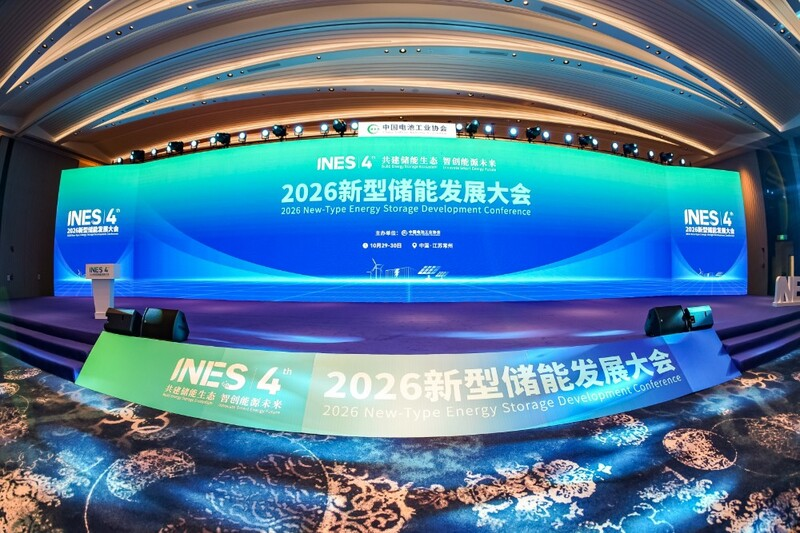
Hosted by China Battery Industry Association, the INES 2026 New-Type Energy Storage Development Conference was successfully held in Changzhou, Jiangsu from October 29 to 30. Centered on the theme of “Build Energy Storage Ecosystem, Innovate Energy Future”, the event gathered more than 500 delegates from government authorities, power grid operators, research institutes, cell manufacturers, ESS integrators, testing & certification bodies, battery recycling firms, foreign trade suppliers and financial institutions. Over two days, participants engaged in in-depth discussions, new product launches and business matchmaking covering industrial policies, cutting-edge battery technologies, multi-scenario deployment, digital operation and global market access for new energy storage sectors.
The conference consisted of one main forum plus six parallel special sessions covering the whole industrial chain: computing-power & grid coordination with green power direct connection, advanced energy storage batteries, “Energy Storage + X” innovative application scenarios, long-duration energy storage, AI-enabled ESS construction and O&M, as well as ESG collaboration and green supply chains for the energy storage industry. The agenda balanced cutting-edge R&D progress and practical pain points in commercial deployment. During the main forum, regulators, academicians and executives from leading enterprises delivered keynote speeches, forecasting the growth trajectory of domestic energy storage, interpreting updated rules on grid connection and safety management, and discussing cross-border challenges including trade barriers, carbon footprint requirements and end-of-life recycling frameworks for overseas expansion.
The highlight of the conference was the official launch of the Integrated Compliance Platform for Energy Storage Battery Digital Passport. As EU battery regulations and local access standards across Southeast Asia keep tightening, exported storage cells, commercial & industrial energy storage systems and swappable batteries for electric two-wheelers face heavy burdens in traceability, certification filing, carbon footprint declaration and customs inspection. This digital platform establishes unified archives covering the full lifecycle of batteries, from raw material tracing, manufacturing records, test certificates and carbon accounting, to second-life application and recycling data. It delivers a standardized compliance toolkit for companies targeting Southeast Asia and Europe, cutting administrative costs for export verification and marking a key milestone for Chinese battery industry to align with international battery passport frameworks.
The parallel sessions shared abundant technical and project cases. The long-duration energy storage track analyzed flow batteries, large-capacity long-cycle cells and compressed air energy storage, discussing cost curves, lifespan limits and commercialization timelines. The “Energy Storage + X” session showcased grid-forming storage, commercial & industrial solar-storage systems, industrial microgrids and immersion-cooled energy storage projects, exploring profitable models for behind-the-meter storage. The AI+ESS O&M session focused on fire safety, remote intelligent monitoring, early warning and digital power trading, introducing risk control solutions for the whole service life of energy storage stations. The ESG and green supply chain session decoded international carbon rules and shared practical experience on low-carbon material sourcing and closed-loop battery recycling, supporting enterprises to build sustainable supply chains.
In the roundtable session, specialists from certification agencies, export traders and overseas local energy storage operators compared subsidy policies, grid codes and localisation requirements in Southeast Asian markets including Indonesia, Vietnam and Malaysia. They sorted out region-specific compliance risks and offered actionable guidance for Chinese battery and swap solution providers. A dedicated business zone was arranged on site, enabling cell suppliers, ESS integrators and battery swap cabinet manufacturers to meet overseas buyers face to face. Multiple preliminary cooperation intentions were reached, accelerating the global rollout of mature energy storage and two-wheeler swap solutions.
As a high-level domestic platform for the new energy storage sector, INES 2026 connects R&D, manufacturing, safety operation, export compliance and battery recycling, building a collaborative channel for industry, academia, research and trade. With rising demand for residential storage, industrial storage and e-bike battery swap services across Southeast Asia, battery compliance, safety standards and low-carbon performance have become core competitive factors for exporters. The newly launched battery digital passport platform and industry consensus formed at this conference will help Chinese energy storage products enter global markets in compliance and capture booming opportunities in emerging Southeast Asian markets.
Post time: Nov-11-2026