

2026 World Power Battery Conference: Trends of Solid-State Battery & Sodium-ion Battery
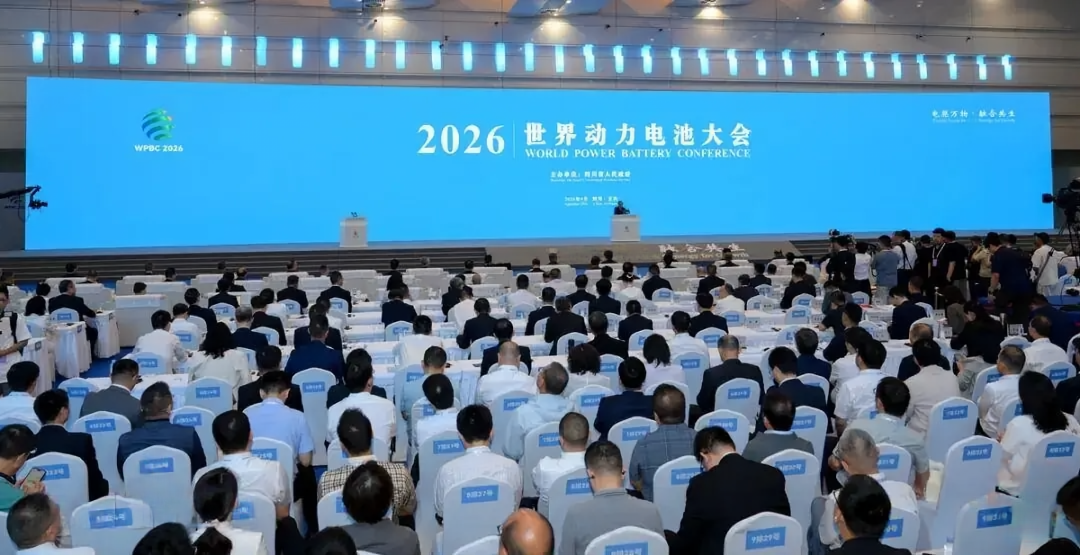 The 2026 World Power Battery Conference, held in Yibin, Sichuan on September 3, has unveiled the latest industrial landscape and future development directions for the global power battery industry. With the theme “Electric Drive for All, Integrated Symbiosis”, the two-day conference covers the entire industrial chain, including power battery policies, solid-state battery technology, supply chain optimization, new energy vehicle applications, energy storage, and battery recycling. It has become an important industry event to judge the power battery development trend in 2026 and the next few years.
China has built the world’s largest and most complete power battery industrial system, occupying a core leading position in global new energy supporting facilities. However, the industry still faces obvious challenges. Internationally, global trade patterns are adjusting continuously, and the industrial supply chain is becoming more regionalized and localized, raising higher requirements for overseas layout of Chinese battery enterprises. Domestically, some core battery technologies still have shortcomings, forward-looking technical research needs to be further strengthened, and there are obvious bottlenecks in retired power battery recycling and reutilization links.
According to the keynote report released at the conference, the future development of China’s lithium power batteries will focus on three major directions: full-process battery safety control, full-industry-chain AI empowerment, and full-life-cycle green and low-carbon manufacturing. More importantly, the industry has officially confirmed a dual battery technology route for future power and energy storage batteries, which will jointly support the iterative upgrade of the new energy industry.
Global First IEC International Standard for Solid-State Battery Led by China
One of the biggest highlights of this conference is the official establishment of the world’s first solid-state battery international standard. The IEC standard proposal led by China has been successfully approved, with experts from Japan, South Korea, France and other major battery countries participating in joint development. This marks that China’s solid-state battery technology accumulation and new energy industry supporting capabilities have been fully recognized by the global industry.
Before the unified standard was released, the global solid-state battery industry was in a chaotic stage with diverse technical routes and inconsistent test specifications, resulting in repeated construction and resource waste. The new international standard uniformly defines solid-state battery terminology, test conditions and evaluation methods, providing a unified technical benchmark for global automakers and battery manufacturers. It will greatly accelerate the industrialization of high-safety and long-cycle solid-state batteries, and promote the upgrading of the global new energy vehicle industry.
It is worth noting that the global solid-state battery is still in the stage of research and development and trial testing, and large-scale mass production has not yet been realized. Although China takes the lead in setting international standards, the global solid-state battery track is still in the early competition stage, and the final technological breakthrough and mass production landing still need continuous technical iteration and engineering verification.
Sodium-ion Battery Industrialization Enters Explosive Growth Stage
Different from the long-term R&D cycle of solid-state batteries, sodium-ion battery industrialization has officially entered the stage from 1 to N large-scale landing in 2026. In the early stage, the development of sodium-ion batteries was mainly driven by lithium price fluctuations, aiming to solve the resource constraints of lithium batteries. At present, the industry driving logic has undergone fundamental changes, and sodium-ion batteries have completely got rid of dependence on lithium price trends.
On the supply side, leading battery manufacturers have completed technical verification and mass production iteration from 2025 to 2026. CATL has successively signed 60GWh long-term energy storage cooperation orders and obtained 7GWh overseas sodium-ion battery orders, fully verifying the engineering feasibility and commercial value of sodium-ion battery products.
On the demand side, the market has shifted from cost-driven to scenario performance-driven. Sodium-ion batteries have unique advantages such as excellent low-temperature performance, fast charging capability, high intrinsic safety and long cycle life. They are widely suitable for AIDC backup power, large-scale energy storage systems, A00-level new energy vehicles and low-temperature scenario vehicles. With rich sodium resources and lower production costs, sodium-ion batteries have become an indispensable supplement to lithium batteries in the new energy storage and power battery market.
Conclusion
The 2026 World Power Battery Conference has clarified the dual-track development pattern of the global power battery industry. In the short term, sodium-ion battery will rely on cost and scenario advantages to achieve rapid industrialization and capacity release. In the medium and long term, solid-state battery will lead the next technological revolution of new energy batteries with high energy density and higher safety. While continuing to consolidate the advantages of the power battery industry chain, China will further export global unified technical standards to promote the healthy and sustainable development of the global new energy battery industry.
Post time: Sep-11-2026