

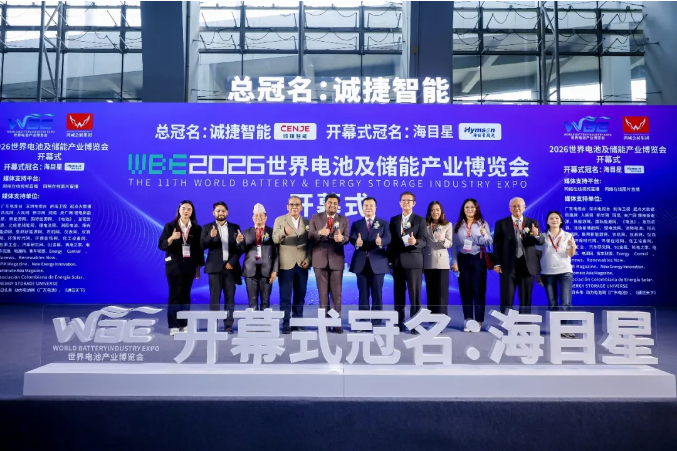
The 2026 World Battery & Energy Storage Industry Expo (WBE Asia Pacific Battery Expo) was held at the Guangzhou Pazhou Complex from September 16 to 18. As one of Asia’s most influential battery and energy storage exhibitions, this three-day event gathered top battery manufacturers, raw material suppliers, system integrators and overseas buyers from Southeast Asia, the Middle East and Europe. It showcased cutting-edge products covering power batteries, energy storage batteries, sodium-ion batteries and two-wheeler EV batteries, and served as a key platform to observe global battery supply chain trends and overseas market demand.
China has built the world’s largest and most complete battery manufacturing ecosystem, holding a dominant position in the global battery export market. Nevertheless, the sector faces multiple challenges. International market access rules and certification requirements are getting stricter. Regional trade barriers are rising, putting forward higher requirements for Chinese battery enterprises’ overseas layout, product safety and carbon footprint management. Domestically, the industry is shifting from blind capacity expansion to high-quality development. Enterprises are accelerating product iteration, while strengthening R&D on low-cost, high-safety battery solutions.
According to on-site exchanges and exhibitor release, the development of China’s battery export business will focus on three core directions: standardized product certification, localized supply chain cooperation, and customized battery solutions for segmented markets. More importantly, the exhibition reflects that overseas buyers are increasingly accepting diversified battery technologies, and lithium batteries, sodium-ion batteries and energy storage integrated systems will jointly support the growth of the global new energy market.
Southeast Asia & Emerging Markets Become New Growth Engine for Battery Export
One of the core highlights of this expo is the sharp rise of purchasing groups from Southeast Asia. Two-wheeled electric motorcycles, distributed energy storage and small household energy storage are the most demanded application scenarios. Many exhibitors mentioned that Indonesia, Malaysia, Thailand and other countries are speeding up the construction of local new energy infrastructure. Local markets have strong demand for low-temperature resistant, low-cost and high-cycle batteries.
Before this expo, many battery export businesses mainly focused on price competition. But buyers’ requirements have changed. Overseas customers now pay more attention to product safety certification, after-sales support and long-term stable supply capacity. A large number of manufacturers have launched battery packs specially optimized for tropical high-temperature environments, which can effectively reduce the risk of thermal runaway in hot climates.
It is worth noting that although Southeast Asia is a high-growth market, enterprises still need to tackle many hurdles. Local import regulations, battery recycling policies and tax rules vary greatly between different countries. Cross-border battery suppliers need to adjust product specifications and certification plans for different target markets.
Energy Storage Large-Cell & Sodium-ion Battery Products Attract Wide Attention
On the product side, leading battery companies displayed upgraded large-capacity energy storage cells and sodium-ion battery systems. These products completed engineering verification and small-batch shipment from 2025 to 2026. Multiple manufacturers have secured framework orders for energy storage projects in Southeast Asia and the Middle East, verifying the commercial value of new battery technologies.
On the demand side, the market logic is transforming from cost priority to comprehensive performance priority. Sodium-ion batteries feature excellent low-temperature performance, fast charging capability and long cycle life. They fit well with low-speed electric vehicles, backup power and large-scale energy storage projects. Supported by abundant sodium resources and controllable production costs, sodium-ion batteries have become an important supplement to lithium batteries in the global energy storage and mobility market.
Conclusion
The 2026 WBE Asia Pacific Battery Expo has demonstrated the new pattern of the global battery industry. In the short run, energy storage batteries and two-wheeler EV batteries will rely on overseas emerging markets to achieve rapid shipment growth. In the medium and long run, diversified battery technologies will coexist and develop, continuously driving the upgrade of the global new energy industry. While consolidating manufacturing advantages, Chinese battery enterprises will further adapt to overseas regional standards, to seize opportunities in the global energy transition.